
Alberta to cut education property tax rate, freeze it for three years
Starting with 2027 tax bills, every Alberta municipality will charge the same provincial education rate: $2.65 per $1,000 for homes and farmland, frozen for three years.

Starting with 2027 tax bills, every Alberta municipality will charge the same provincial education rate: $2.65 per $1,000 for homes and farmland, frozen for three years.
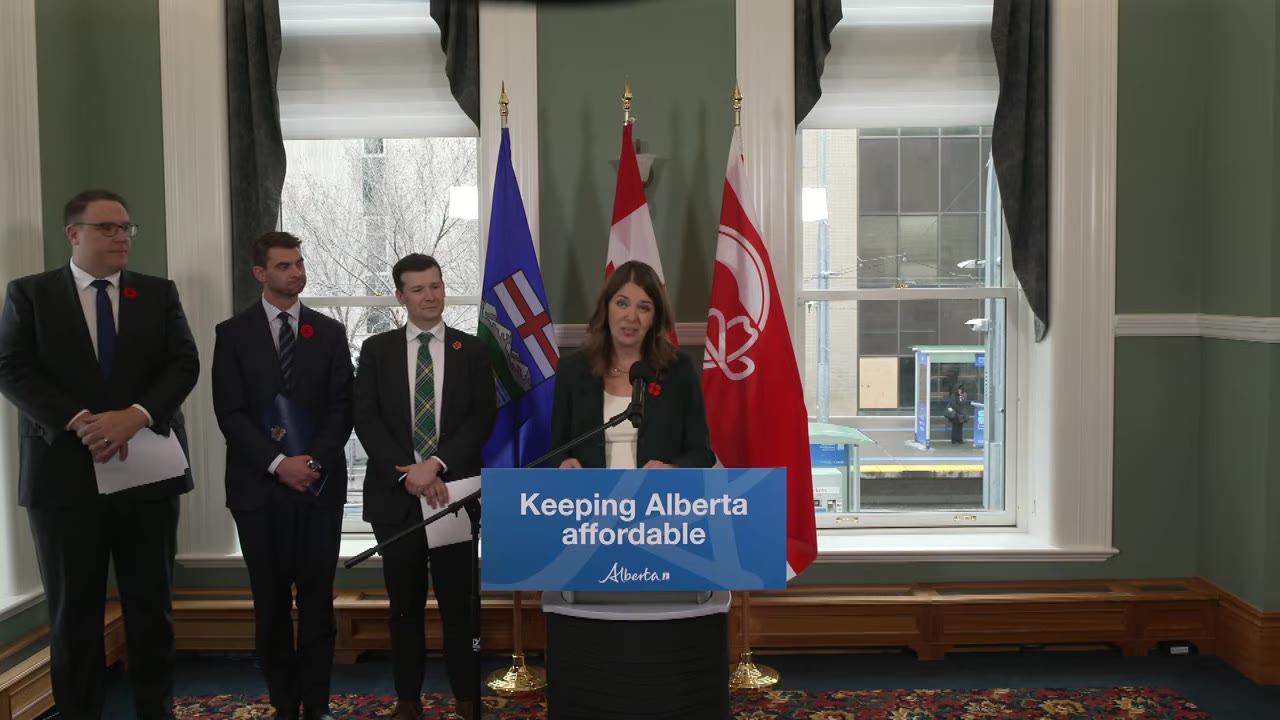
The change takes effect with 2027 property tax bills. The province says it will save property owners nearly $100 million in 2027-28.
"I'm happy to announce that Alberta's government will be reducing the education property tax rate, freezing the rate for three years, applying it fairly to residents and businesses in all municipalities, and giving greater certainty through Budget 2027," Smith said.
Premier Danielle Smith announces the education property tax change at Calgary City Hall on Oct. 30, 2026. (Video: Government of Alberta)
The education property tax is the provincial share of every property tax bill. Municipalities collect it and send it to Edmonton, where it pays for about a third of the operating cost of kindergarten to Grade 12 schools.
Until now, the province has set a total amount, or requisition, for each municipality based on assessments from two years earlier. Each council then set its own local education rate to raise that amount, so the rate on a tax notice varied from town to town and didn't match the rate announced in the provincial budget.
Finance Minister Jason Nixon said that system "does not pass the clarity test."
Starting in 2027, every municipality will apply the provincial rate directly to each property's current assessment. The rates will be:
"That will be the provincial education property tax rate on your bill in Fort McMurray, in Medicine Hat, in Calgary, and in my home of Sundre," Nixon said. "For three years, the province will not increase the education property tax rates. Three years, no surprises, no moving targets."
Finance Minister Jason Nixon lays out the new provincial rates. (Video: Government of Alberta)
Communities where the new standard rate is higher than their current local rate will get a one-time transition tax credit in 2027, paid from general revenue.
Municipalities will still collect the tax on the province's behalf. There will be no separate provincial bill, Nixon said, and the education funding approved in Budget 2026 will not be cut.
Medicine Hat's 2026 education tax rate for single-family homes is 2.6937 mills, or about $2.69 per $1,000 of assessed value, according to the City of Medicine Hat.
At the new provincial rate of $2.65, the education portion of the bill on the city's average single-family home, assessed at $359,500 this year, would be about $953. That is roughly $16 less than at this year's rate, before any change in the home's assessment.
The city collected about $32.5 million for the province's education requisition in 2026, about 24 per cent of what it collects from Medicine Hat property owners.
Because the new rate will be applied to each year's assessment, a rising assessment can still push a homeowner's education tax up even while the rate is frozen.
Municipal Affairs Minister Dan Williams said the province will no longer bill municipalities a lump sum. Legislation is expected this spring so 2027 tax notices can go out at the new standard rate.
"This clarifies for municipalities and for ratepayers to know where the money is going and exactly how much is owed every single year," Williams said.
Municipal Affairs Minister Dan Williams explains how the new standard rate will be applied. (Video: Government of Alberta)
Williams said the new model reacts right away to changes in assessed values, instead of the two-year lag under the old equalized assessment formula. A $250,000 property in Calgary will pay the same education tax as a $250,000 property in Edmonton, a rural county or a small town, he said, an approach he said is closer to how British Columbia, Saskatchewan and Ontario handle it.
Calgary Mayor Jeromy Farkas, who has pushed the province on the issue, said 42 cents of every residential property tax dollar collected in Calgary goes to the province. He said 15 municipal affairs ministers had told him they would look at the formula. "You looked at it, not words, action, and here we are," he told Smith.
Paying for it: Asked how the province will replace about $100 million in revenue, Nixon said it will be absorbed through general revenue. Details will come in Budget 2027, he said, adding there is "no intention" to reduce education spending this year.
Nixon on how the province will cover the roughly $100 million in lost revenue. (Video: Government of Alberta)
No one pays more, Nixon says: Asked whether the transition credit would cover the full increase in communities facing a higher rate, Nixon said it "will represent the entire difference."
"Assuming assessment values froze all across the province and nobody's house went up or down ... nobody will pay more than they would have paid before this, and the vast majority will pay less," he said.
Nixon on the one-time transition tax credit. (Video: Government of Alberta)
After the freeze: Asked whether the freeze could lead to a sharp jump when it ends after three years, Nixon said the province is "not actually convinced" that will happen. Rising assessments may keep revenue where the province wants it, and if the province ends up collecting too much, the rate could come down, he said.
"Buying votes"? A reporter noted the UCP's loss in the Calgary-Shaw byelection and polling suggesting the government has taken a hit over the 10th question on the Oct. 19 referendum, and asked Smith whether the announcement amounted to buying votes in Calgary.
Smith said the government heard "loud and clear" that the issues it had been debating in recent months were not top of mind for Calgarians, who care more about taxes, schools, hospitals and getting to work.
"There's always a bit of a difference between the kinds of policies and debates that take place at AGMs and maybe in rural Alberta, but you can do both," she said, calling the tax change "the first step" in focusing on issues that matter to Calgary voters.
Smith responds to a question about whether the announcement is aimed at winning back Calgary voters. (Video: Government of Alberta)
In other questions, Smith said the province will unveil a new oil sands royalty framework before the end of November and confirmed she supported the UCP executive director's decision to cancel Jeff Rath's party membership. She said Rath has said he wants to turn the UCP into an independence party, "and we are not an independence party."
Nixon said more details will come when Budget 2027 is tabled early next year.
Watch the full news conference: